

Mary Knoll Park: An Extravagance of Autumn!
November 9, 2026 | Topics: Places, Stories
In Memoriam: Annie Dillard 1945 – 2026
By Eddee Daniel
“We are here to witness the creation and to abet it.” ~ Annie Dillard
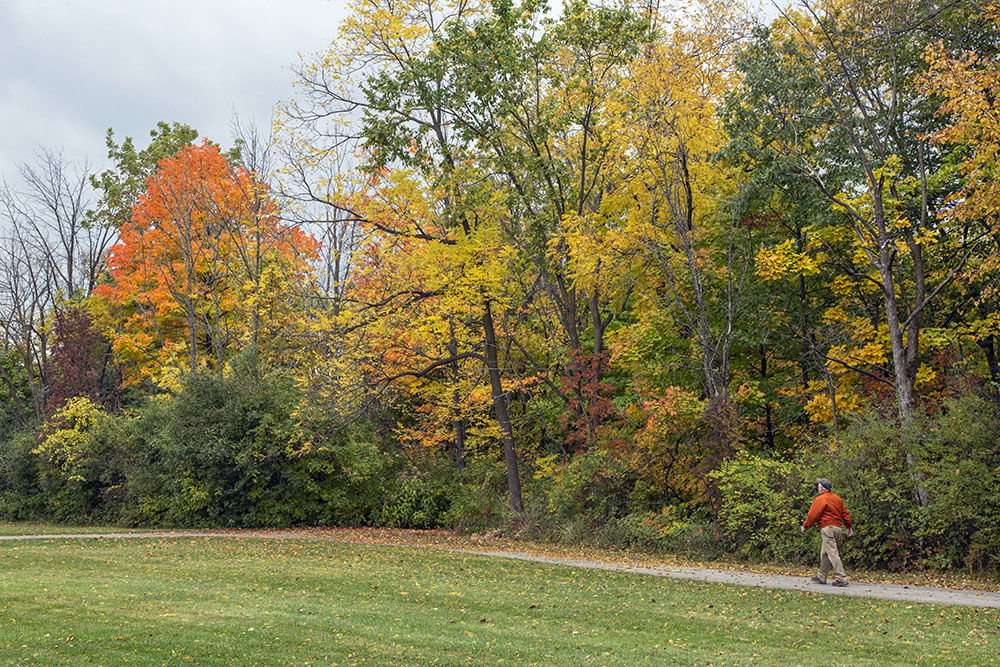
We know a tree doesn’t willfully decide what color its leaves should turn in the fall; it’s a matter of temperature, humidity and other meteorological conditions. What I wondered, however, as I took this photo (below), was whether the man chose the color of his jacket knowing it would match the tree. Or some tree, to make a connection with autumn. Do you mindfully harmonize with nature, with the seasons? Earth colors for autumn, bright pastels for spring, and so on. And the more important question is, if we can harmonize in such a seemingly trivial fashion as the color of our clothes, what might we do about, for example, climate change?
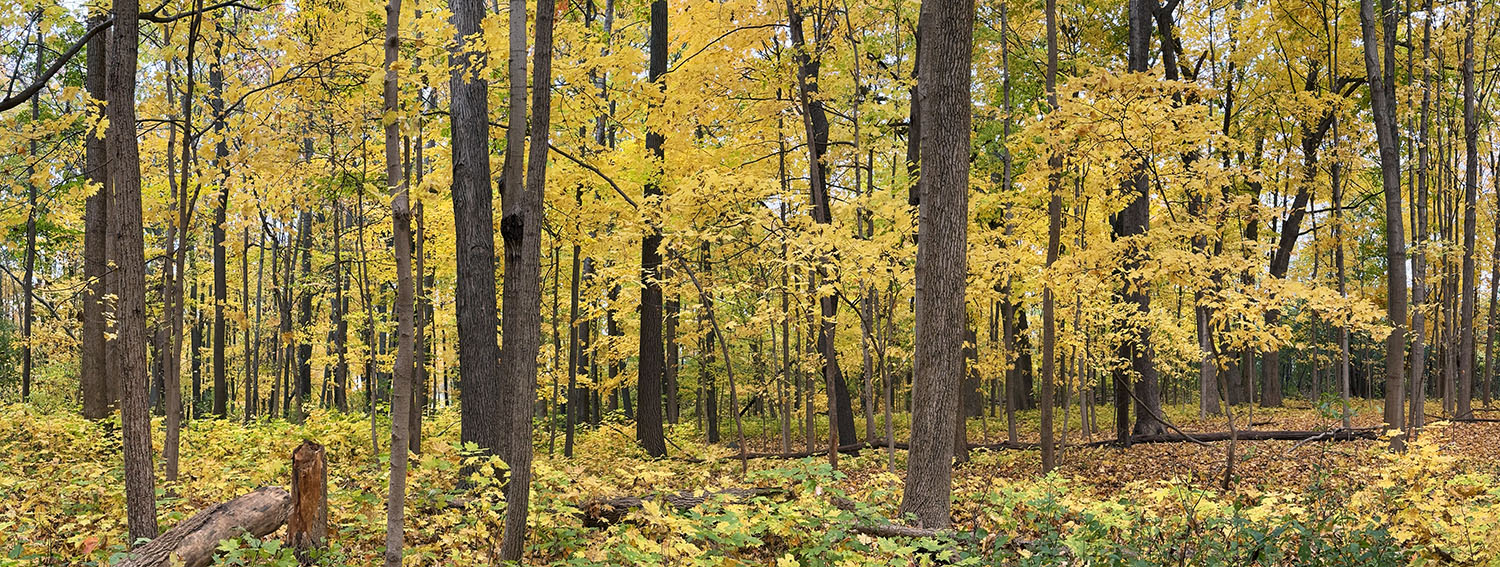
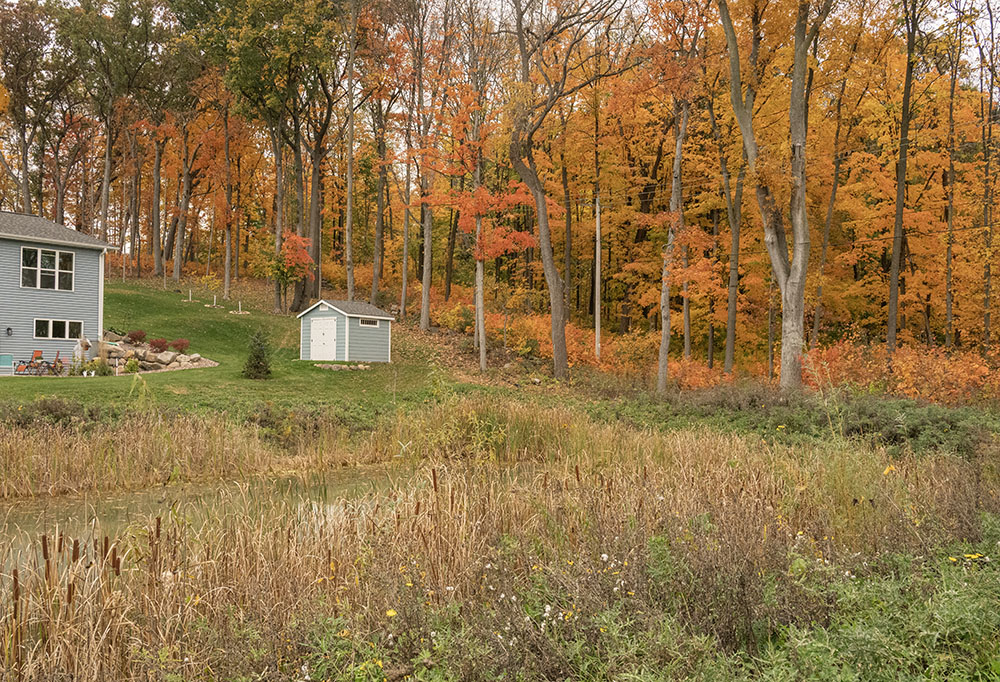
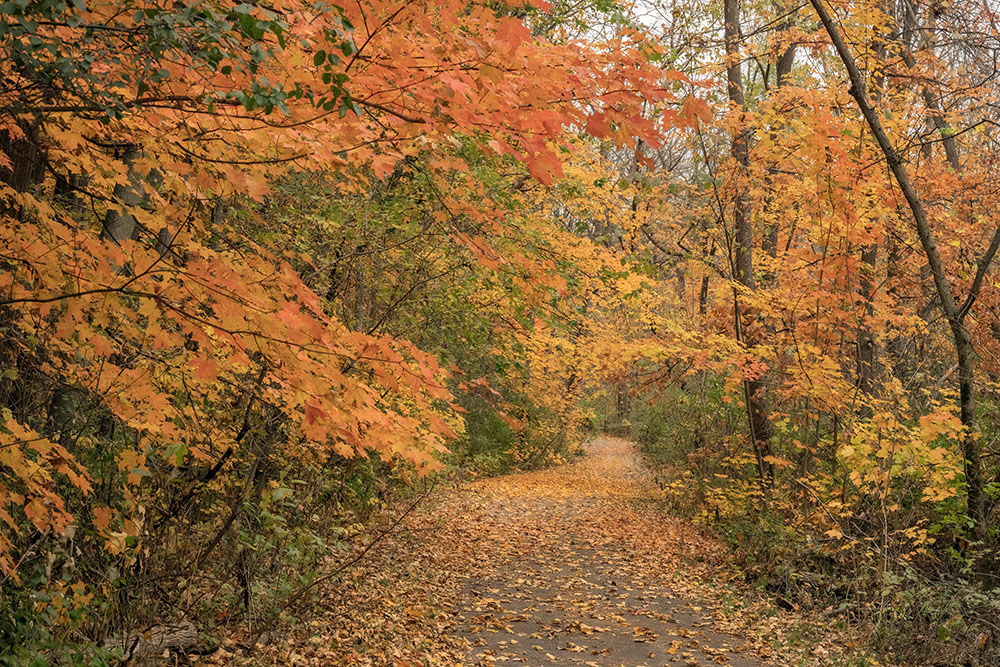
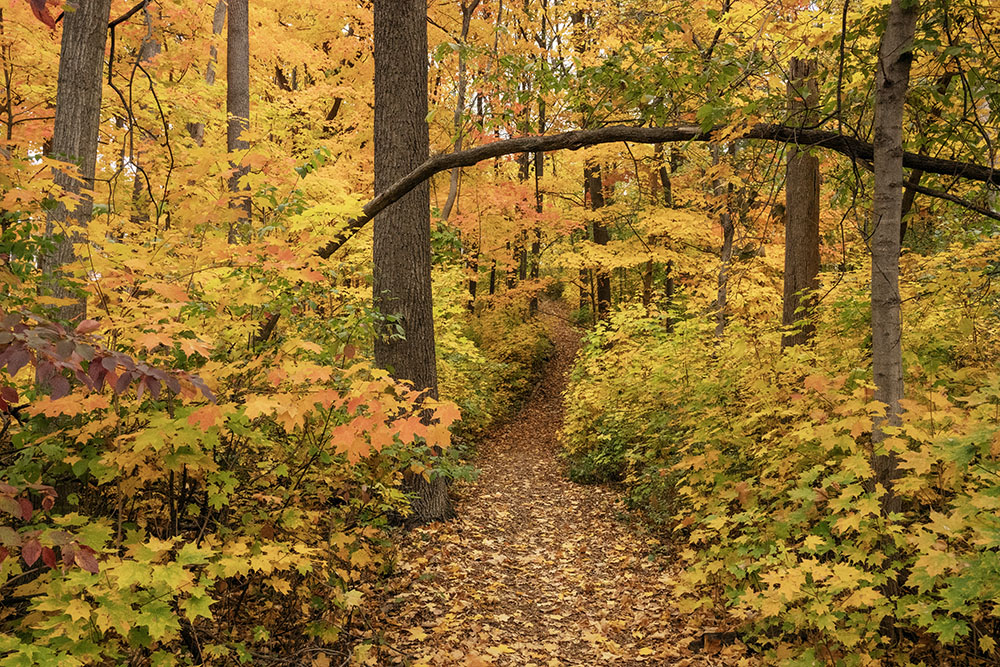
Annie Dillard was a master at making connections like the above between micro and macro phenomena. If you haven’t read her Pulitzer Prize winning book, Pilgrim at Tinker Creek, I highly recommend it. My own copy is dog-eared, underlined, and littered with Post-it notes. It sits on the book shelf over my desk in good company with A Sand County Almanac, and Walden. I’ve been wanting to pay homage to her here since she died in September and a recent foray in Mary Knoll Park in Brookfield is the perfect opportunity. As you can see from the images, the peak autumn foliage in the park was extravagant to an extreme. And Dillard was all about the extravagance of nature:
“After the one extravagant gesture of creation in the first place, the universe has continued to deal exclusively in extravagances, flinging intricacies and colossi down eons of emptiness, heaping profusions on profligacies with ever-fresh vigor. The whole show has been on fire from the word go. I come down to the water to cool my eyes. But everywhere I look I see fire; that which isn’t flint is tinder, and the whole world sparks and flames.”
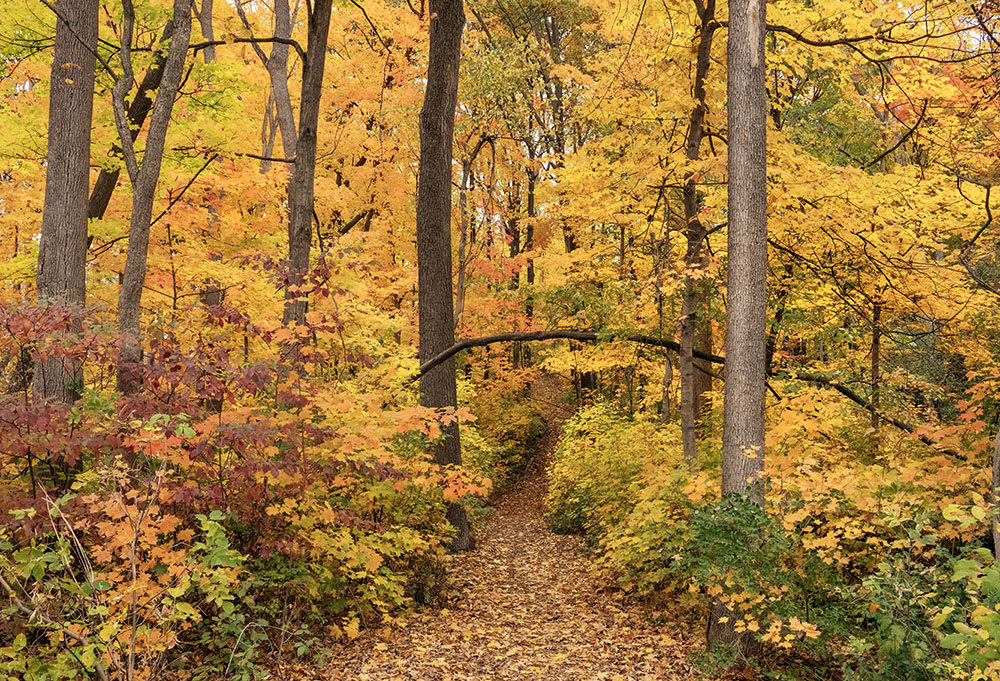
Mary Knoll Park is not large. Its twenty acres includes an array of four tennis courts, a small playground and a large water tower. The Deer Creek Recreation Trail, part of the Brookfield Greenway System, runs the length of it. The park snuggles up against I-94, the constant drone of which provides an incessant sound track. But most of the property is forested and the land slopes away from the freeway, which helps to reduce the noise to a fading memory as you walk in the breathtaking woods. As Dillard reminds us again and again in “Tinker Creek,” it is up to us to be present, to experience the beauty. Why else is it there?
“The answer must be, I think, that beauty and grace are performed whether or not we will or sense them. The least we can do is try to be there.” ~ Annie Dillard
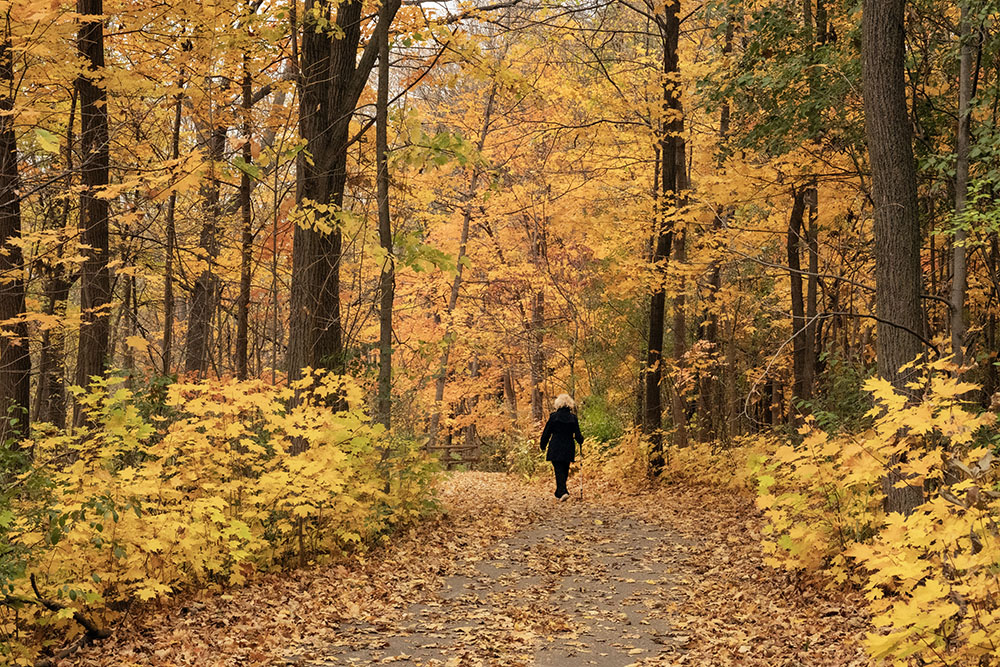
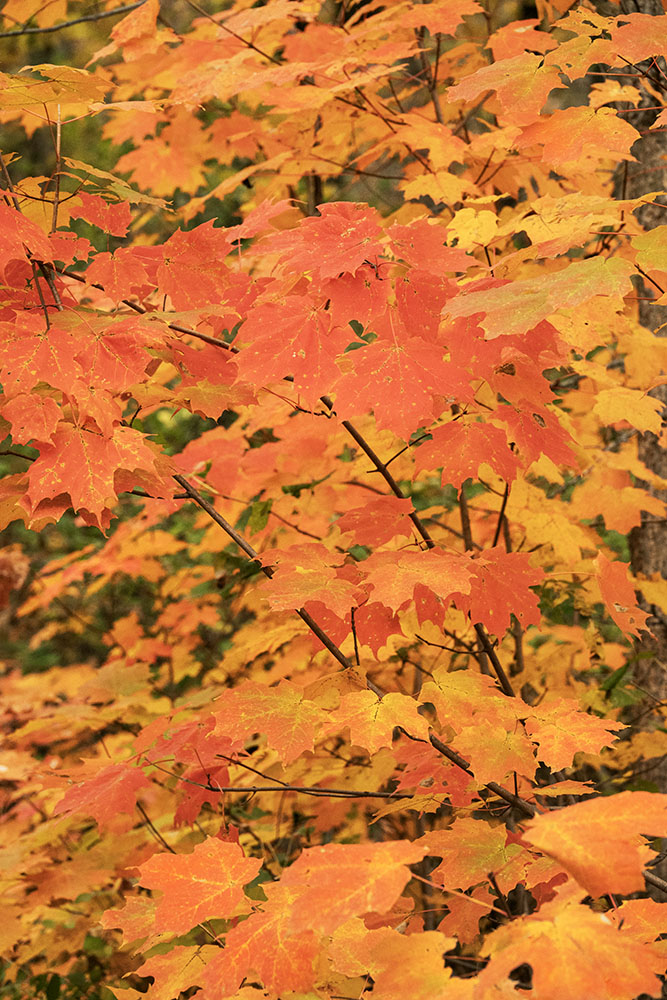
Of what evolutionary value are the brilliant colors. Why red? Why orange? Why yellow or gold? The green leaves could just as well go straight to dull brown, taupe, or umber. Some species do just that. This year, in fact, it seemed as though much of the foliage bolted through the seasonal variations far more quickly than usual. That I managed to catch the colors of Mary Knoll at their peak was almost entirely a matter of luck. I say almost because I was fairly persistent in my seasonal search. But I never underestimate the value of luck. The day I visited this park, it was the third place I tried. The other two, not far away, were disappointments—as far as the autumn colors went. Chance favors those who are prepared.
“I am no scientist. I explore the neighborhood. An infant who has just learned to hold his head up has a frank and forthright way of gazing about him in bewilderment. He hasn’t the faintest clue where he is, and he aims to learn.” ~ Annie Dillard
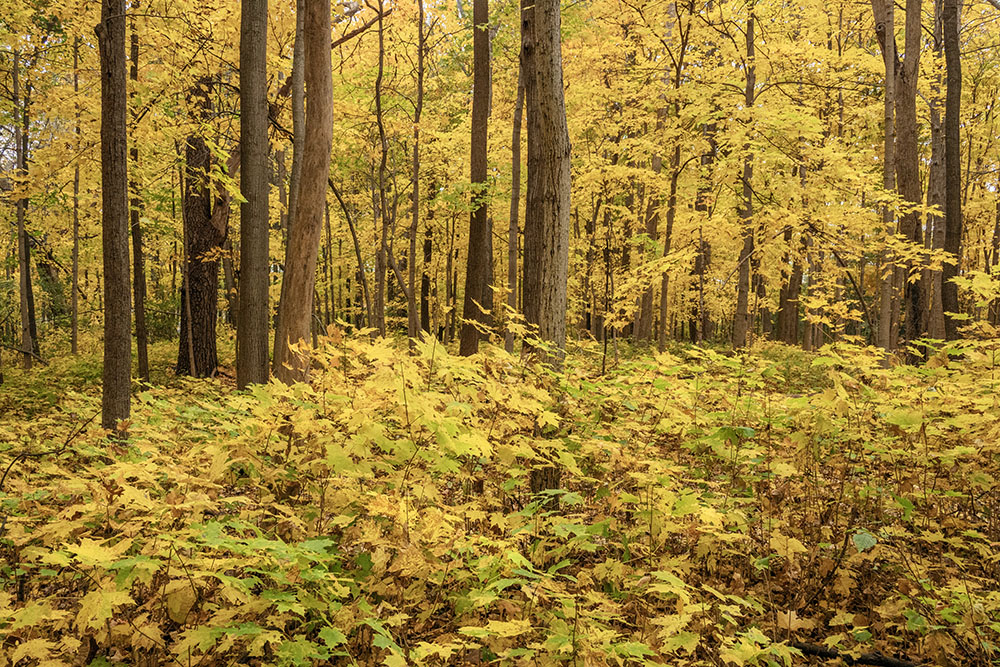
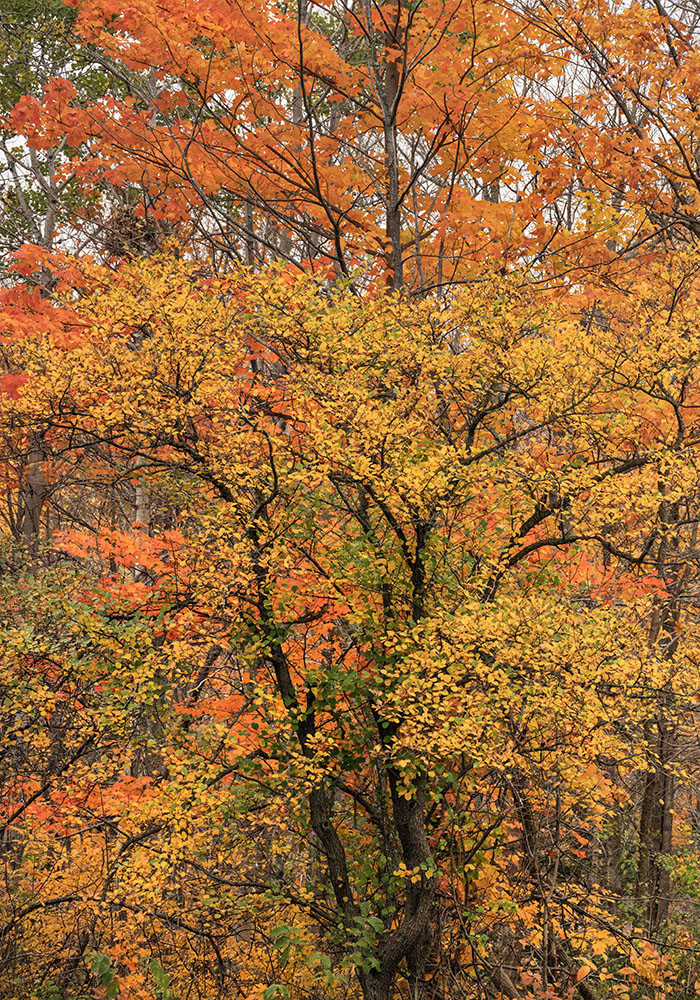
In fact, it was the blaze of yellow foliage flashing by as I drove along the freeway on the way to the other two parks that drew me to return to Mary Knoll after those disappointments. I could see, even from a distance and at freeway speeds, that the third try would be a charm. The maples are the thing. From the family Aceraceae, there are over 130 species of maple trees worldwide. Three of them dominate in Wisconsin, the silver maple, red maple, and especially the sugar maple—famously the source of maple syrup.
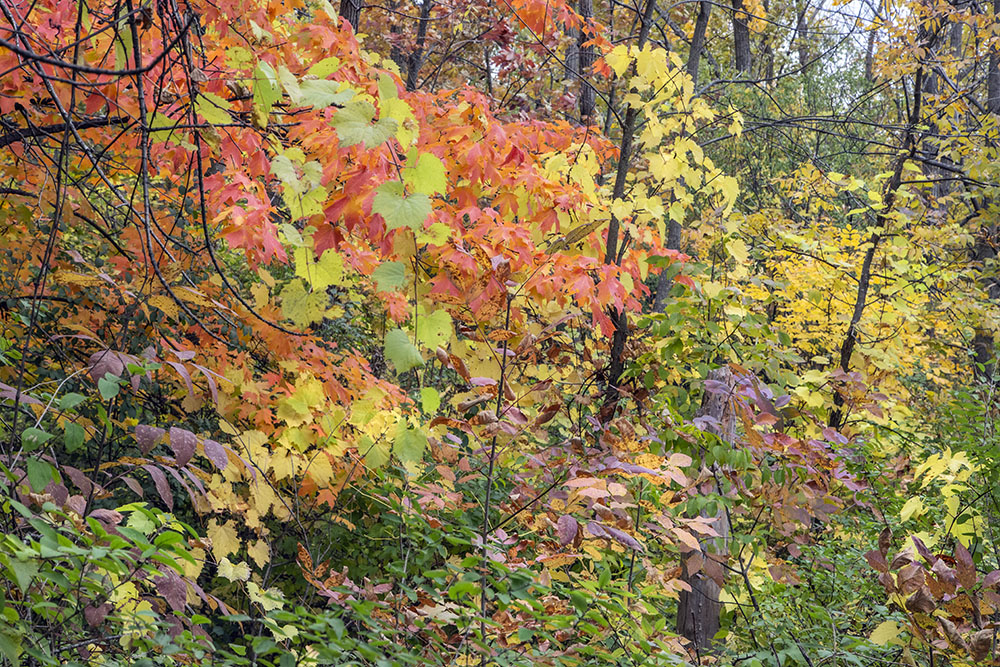
The forest at Mary Knoll that day was a kaleidoscope of colors. Although yellow prevailed overall, every autumn shade imaginable made an appearance. I have it on good authority that the particular species of maple cannot be discerned by the color of the leaves, which are infinitely variable due to not only the atmospheric conditions mentioned earlier, but also the microclimate of the location: top or bottom of the hill, nearer the edge or the center of the woodland, etc. I would be willing to bet that all three of the dominant species are present at Mary Knoll, maybe more! I feel confidant identifying only the silver maples, the leaves of which are more striking, spikier looking. But they were the minority. Sugar maples most likely the majority. Dillard has much to say about details:
“That there are so many details seems to be the most important and visible fact about the creation. If you can’t see the forest for the trees, then look at the trees; when you’ve looked at enough trees, you’ve seen a forest, you’ve got it.”
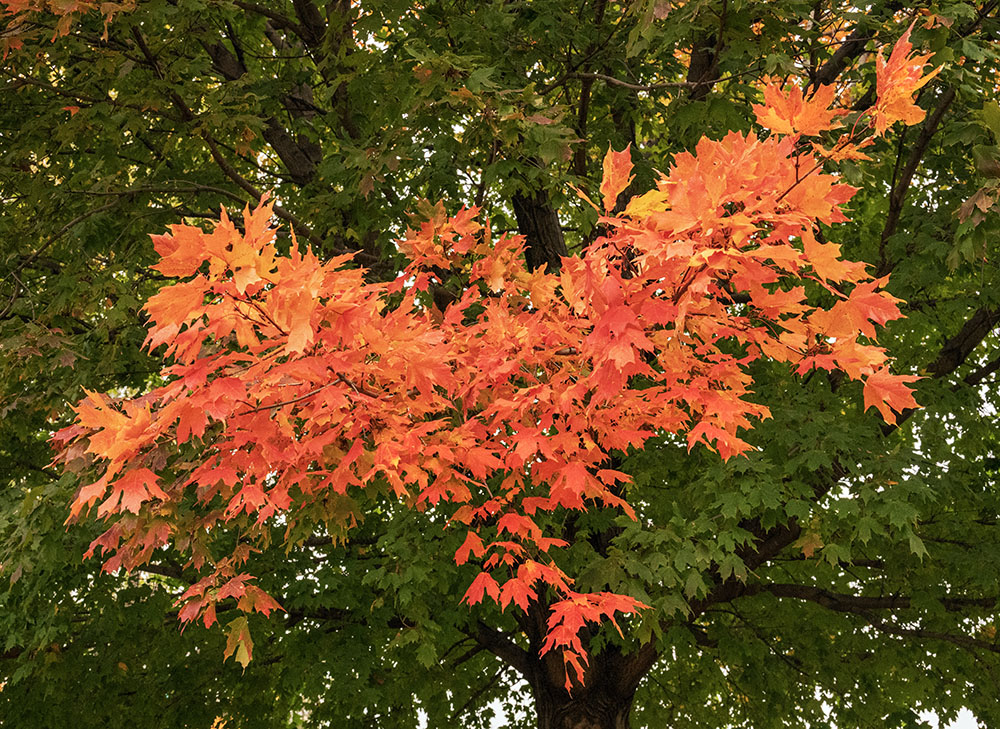
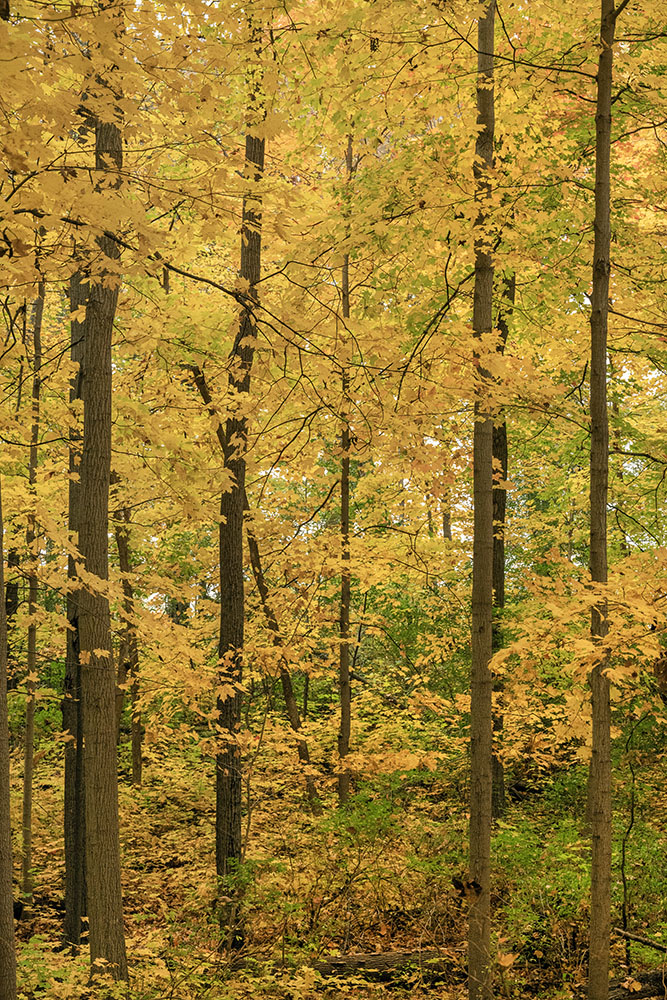
While you’re looking at all the trees, glorious and majestic as they are, be sure to pay some attention to the other denizens of the forest. While I was there that day, the only animals I saw were several gray squirrels and a lone whitetail deer passing among the trees like a ghost. I heard a number of birds, but never caught a glimpse. Surprisingly, for mid-day and mid-week, I saw more people on the trails than animals in the forest. Or perhaps not so surprising, given the spectacular show the leaves were putting on. We as a species do like pizazz, don’t we? While the animals just keep on going about their business.
“The great hurrah about wild animals is that they exist at all, and the greater hurrah is the actual moment of seeing them. Because they have a nice dignity, and prefer to have nothing to do with me, not even as the simple objects of my vision. The show me by their very wariness what a prize it is simply to open my eyes and behold.” ~ Annie Dillard
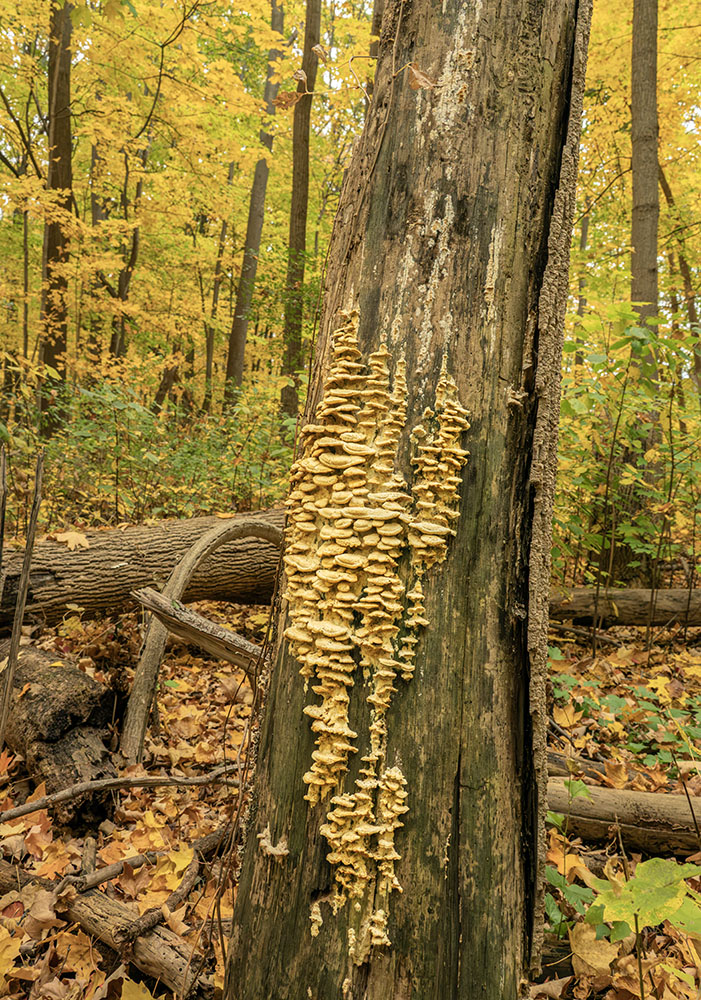
When a tree dies in the forest, fungi are among the beneficiaries. A colony of mushrooms has erupted from this dead trunk. These are called polypores, aka bracket or shelf fungi. They contribute to the decomposition of trees, breaking down the wood, recycling its nutrients and aiding the health of the soil. Which in turn enables more trees to grow, continuing the cycle of life in the forest. Which in turn, if properly husbanded, enables us to enjoy season after season of spectacular autumns at Mary Knoll Park. Which makes us beneficiaries as well.
“Our life is a faint tracing on the surface of mystery, like the idle curved tunnels of leaf miners on the face of a leaf. We must somehow take a wider view, look at the whole landscape, really see it, and describe what’s going on here. Then we can at least wail the right question into the swaddling band of darkness, or, if it comes to that, choir the proper praise.” ~ Annie Dillard
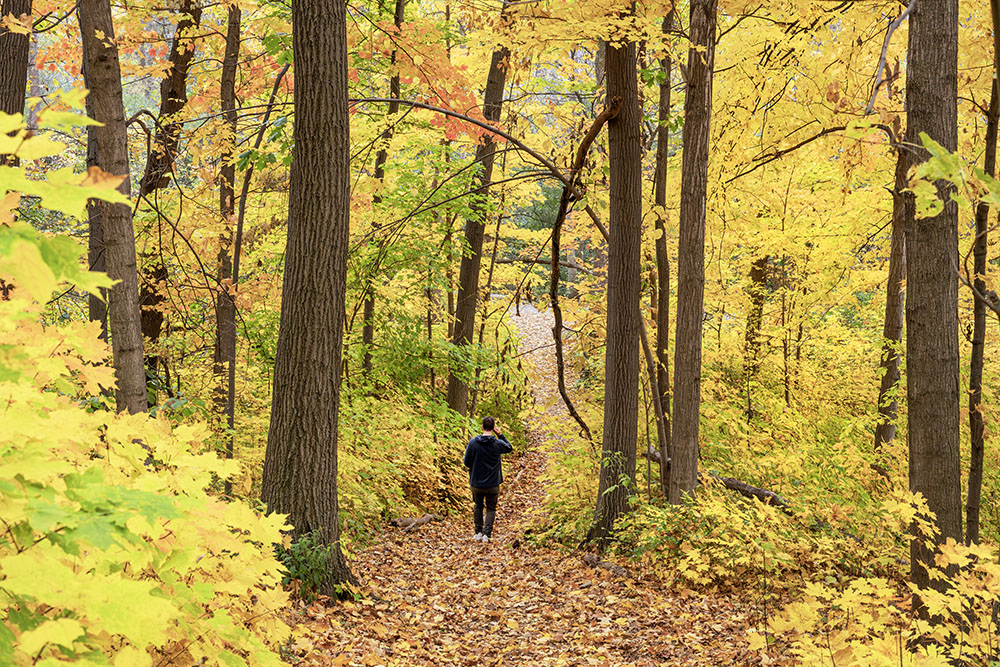
I walked the length of the park and on out the far side where the Deer Creek Trail releases you into the neighborhood. Common experience in any urban/suburban park like this one. Looking back the colors, more orange than yellow from that perspective, seemed even more intense. The contrast with the neighborhood was striking. The adjacent property owner happened to be out using a leaf blower; it managed to drown out the sound of the freeway completely. I turned around and reentered the forest.
Annie Dillard writes with breathless, exclamatory prose about the magnificence and intricacy of nature. I include quotes here, mostly from Pilgrim at Tinker Creek, but the true quality of her writing is not easily quotable. She’s a storyteller. Her stories are woven together like a fine tapestry. Quoting a single sentence or paragraph is like pulling a thread out of the tapestry. The colored fiber in your hand can contain neither the majesty nor the meaning of the whole. With apologies and abashment, I leave you with a final quote:
“Caring passionately about something isn’t against nature, and it isn’t against human nature. It’s what we’re here to do.” ~ Annie Dillard
For more information about Mary Knoll Park, as well as photos from other seasons, go to our Find-a-Park page.
Related Stories:
Kettle Moraine in the rain: Autumn color and fantastic fungi!
Odyssey in Autumn: The season of contradiction.
Photo Essay: Autumn Splendor on the Root River
An Autumn Foray and a Season of Fragility
Autumn Splendor on the Ice Age Trail – Milwaukee River Segment!
Autumn Odyssey 7: A World of Trees
Eddee Daniel, writer/photographer, is a board member of Preserve Our Parks, the Program Director of A Wealth of Nature, and editor of The Natural Realm blog. Read more or subscribe at awealthofnature.org. Also available by arrangement for group presentations and guided tours.
The Natural Realm blog is part of A Wealth of Nature, which is a program of Preserve Our Parks.
About Preserve Our Parks
Preserve Our Parks, Inc. is an independent nonprofit organization dedicated to the preservation of parks and green spaces. Our mission: To advocate for and promote Milwaukee area parks and open spaces and to strive to protect the tenets of Wisconsin’s Public Trust Doctrine.
For more than 25 years, we have been a leader in advocating for the protection of Milwaukee County park lands, halting many proposals to develop, privatize, or sell local parkland and lakefront spaces. More information about POP, including past accomplishments, is available at www.preserveourparks.org.